AirDroid Parental Control
24/7 Kids' Guardian via App & Web
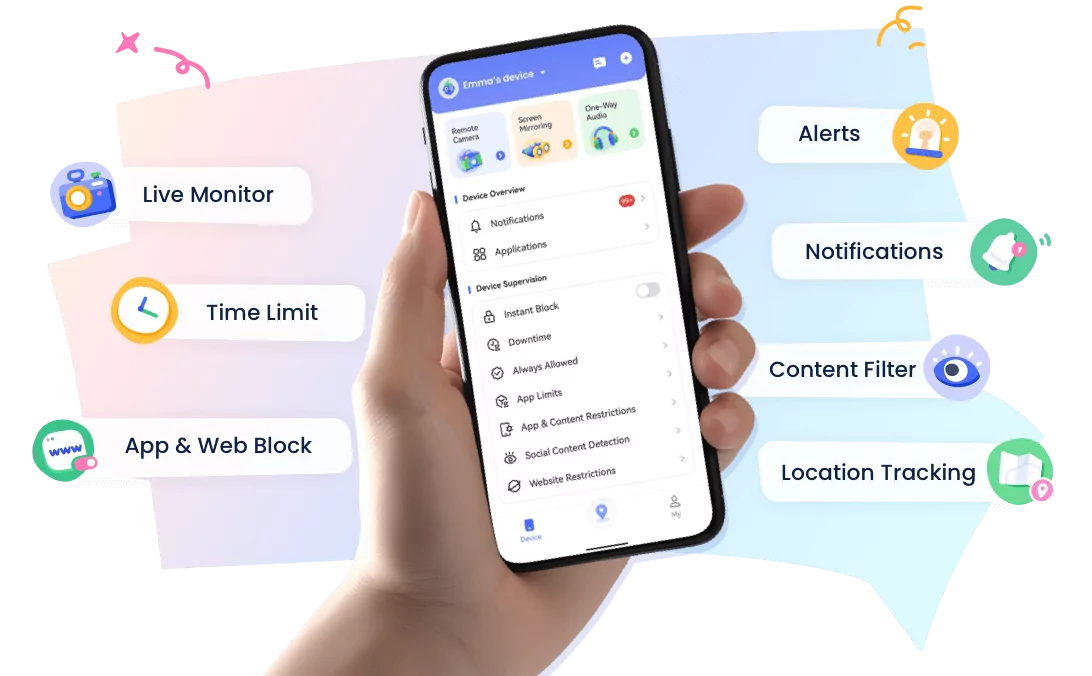
- 👀Live surroundings and location tracking
- 🔞Content Monitoring and App/Web Blocking
- ⚠Instant alerts for online risks and geofences
- ⌛Screen time control and monitor
What are the Dangers of Snapchat? A Complete Safety Guide for Parents
According to the 2025 Piper Sandler Teen Survey, Snapchat is the third most popular app among teens, with a 14% usage rate.
Parents may be curious why teens love Snapchat so much; the draw often lies in its vanishing messages and addictive "Snapstreaks."
However, these engaging features often mask concealed dangers. The pressure to stay connected can lead to sensitive content sharing, stranger manipulation, or location exposure.
While these risks are concerning, simply confiscating devices is rarely a long-term solution. Instead, understanding each vulnerability is key. This guide will help you identify specific threats and take proactive steps to protect your child's digital life.
Content & Emotional Risks (Disappearing Messages & "My Eyes Only")
The false sense of privacy on Snapchat tends to promote irresponsible conduct, putting children at risk of severe emotional and online dangers.
1Disappearing Messages
Children often send impulsive content under the illusion that Snapchat messages vanish forever. However, this sense of security is largely manufactured; receivers can easily bypass the app's restrictions to save and leak media, often leading to the devastating spread of sensitive images.
This gap between perception and reality is no accident — the FTC's settlement with Snapchat confirms that the company deceived consumers by falsely claiming its messages disappeared forever, while failing to disclose that it collected users' location data and had significant security flaws.
Once private content is maliciously archived, the "disappearing" promise turns into a persistent nightmare. Because the damage often happens behind the screen, parents must stay vigilant for sharp emotional fluctuations in their children, which frequently serve as the first red flag that digital risks are bleeding into real life.
To bridge this gap, tools like AirDroid Parental Control offer a proactive defense, using content detection to provide early warnings.
In an era where past security breaches have already exposed millions, such guidance is no longer optional—it is a crucial safeguard for a child's digital footprint.
2My Eyes Only: The "Absolute Black Hole" in a child's phone
The "My Eyes Only" feature creates a secret, locked space where teens often hide sensitive content, increasing the risk of leaked teen Snapchat nudes and online grooming.
According to the Journal of Computer-Mediated Communication, adolescents also create secondary "Finsta" accounts or hidden digital spaces to share negative feelings and their actual social reality. Because these hidden accounts often contrast with their positive main profiles, they frequently become targets for cyberbullying.
Parents can identify potential red flags by checking the time spent in Snapchat's "Memories" or by using the snapchat parental control tool to detect risks. It is also highly recommended to set up the official Snapchat Family Center to see who your kids are messaging. Have open conversations about wanting to scan for threats so your child doesn't have to face digital blackmail alone.
3Filters & Beauty Effects
According to a medical study archived by the National Institutes of Health (NIH), beauty filters are no longer just harmless fun; they are increasingly linked to body image anxiety and a clinical phenomenon known as Snapchat dysmorphia.
The research reveals that these filters drive individuals to become obsessed with altering their physical appearance through cosmetic surgery to match their digitally perfected images.
These false realities create unattainable beauty standards that can severely damage a child's self-esteem and mental health.
You can spot early signs of this by watching if your child obsessively takes and edits selfies. Also, watch out when they say they feel so inferior when they see their original, unedited photos, or complain about physical imperfections that no one even pays attention to.
In supporting your child, you need to engage in open, non-judgmental conversations about healthy beauty standards and online insecurities. With positive communication, you can help them overcome these digital standard traps to restore true self-acceptance.
4My AI
Children often view Snapchat's "My AI" as a safe confidant, but an experiment shows it can provide highly age-inappropriate and dangerous advice. For instance, the AI has previously taught a 13-year-old how to lie to parents and offered romantic tips for sexual activities.
Besides inappropriate content, interacting with this AI carries a massive risk of exposing children's personal data. Investigations by the ICO have shown that the platform initially failed to assess privacy risks to minors, making data protection a critical ongoing concern.
To mitigate these threats, parents must openly mentor their children through all online interactions without being judgmental. Discussing technology boundaries will help your child critically evaluate internet advice and protect their personal information.
Stranger & Social Risks (Quick Add, Discovery)
The Quick Add option enables strangers to invade the social network of a child by posing as their peers. An article from The Guardian throws light on this grim truth, explaining how an 11-year-old in Australia was abused after adding an unknown person to earn Snapchat points.
Digital predators are proven to frequently exploit these instant connections and disappearing messages to groom their victims. Additionally, children face severe psychological pressure from online bullying, social exclusion, and anonymous screenshot sharing within these circles.
Therefore, you need to recognize early signs, such as your child receiving expensive digital gifts or keeping a newly met online "older sibling" a secret. Warning signals usually appear when a stranger pressures your child to move the conversation to more private, encrypted software.
To avoid this, talk about the dangers of online communication as early as possible and instruct your child to block and report suspicious accounts. If your child is not mature enough to handle these open networks, consider transitioning them to a dedicated, safe messaging app for kids that limits random stranger interactions. If the situation already shows signs of exploitation, report the evidence to the local police or other specialized protection organizations.
Location & Snap Map Risks
The Snap Map feature automatically broadcasts the specific location of a child whenever they open the app. This tracking system makes it very easy for outsiders to deduce a child's daily routine, including mapping out their home and school addresses.
As a result, both real-life acquaintances and unknown predators can misuse this track record to carry out physical stalking. NSPCC also highlights that constant location updates make children highly vulnerable to becoming targets for offline bullying and exploitation.
This risk is significantly amplified because children often lack the cognitive maturity and critical thinking skills to evaluate long-term consequences, making them more susceptible to accepting friend requests from strangers without a second thought.
To address this, you need to discuss implementing the "Ghost Mode" feature with your child so their position is hidden from the map. By reminding them to reconsider who should know their whereabouts, you help safeguard their personal life from dangerous public exposure.
Usage Habit Risks—Snapstreaks, Stories/Spotlight, Notifications/Auto-play
The interminable scrolling of Stories and Spotlight, along with autoplay, is meant to keep children staring at their phone screens. As a result, adolescents receive an average of 237 phone notifications per day, constantly prompting them to check their phones.
This constant flow of notifications may disrupt their education and destroy their sleeping patterns because they keep staying up late. Moreover, children have a strong social obligation to maintain Snapstreaks, driven by fear of missing out (FOMO).
The platform creates psychological pressure on the child to make a digital check-in. Ultimately, they feel emotionally tied down and dragged along by algorithmic mechanisms that demand their endless presence.
Instead of forcibly confiscating their phones, parents should start guiding their children toward more balanced digital usage. Discussing a response script helps them break the social anxiety of stopping a Snapstreak, equipping them to set mutually agreed-upon technology boundaries. Additionally, make sure you look into advanced built-in safeguards like the Snapchat 3 layer security protection to restrict automated tracking and excessive ad profiling.
Conclusion
Deciding when to allow a child on Snapchat requires a careful balance of trust and oversight. Before saying yes, parents can use a pre-download checklist to evaluate readiness; if the assessment shows a "Low Risk" score, it may indicate your child is prepared for the responsibility.
However, a green light doesn't mean a hands-off approach. Children still require active parental guidance to navigate Snapchat's intricate social dynamics.
As a practical first step in this journey, you can leverage the app's Family Center to discreetly monitor their friend list and better understand their digital social patterns.
To get much more extensive protection, you can consider using specialized guidance software such as AirDroid Parental Control. This app is highly helpful for predicting potential risks, as it provides real-time alerts whenever there are signs of danger.
These digital protections are secure, but when combined with active parental attention, they will do the most to protect your child on the Internet. Establishing a clear Snapchat family digital agreement ensures both parties are on the same page. A mix of safeguarding technology and open communication will help you lead your child safely through the cyber world.
List of Sources
- Snapchat Popularity & Usage Trends
- Piper Sandler — Taking Stock With Teens Survey Spring 2025 (https://www.pipersandler.com/teens)
- AirDroid Blog — Why Do Teens Use Snapchat? (https://www.airdroid.com/parent-control/why-do-teens-use-snapchat/)
- Common Sense Media — Constant Companion: A Week in the Life of a Young Person's Smartphone Use (https://www.commonsensemedia.org/research/constant-companion-a-week-in-the-life-of-a-young-persons-smartphone-use)
- Content, Privacy & Emotional Risks
- Federal Trade Commission (FTC) — Snapchat Settles FTC Charges Regarding Disappearing Messages (https://www.ftc.gov/news-events/news/press-releases/2014/05/snapchat-settles-ftc-charges-promises-disappearing-messages-were-false)
- Journal of Computer-Mediated Communication — Adolescents' Social Media Use and Well-being (https://academic.oup.com/jcmc/article/27/4/zmac009/6649192)
- National Institutes of Health (NIH) — The Impact of Social Media Filters on Body Image (https://pmc.ncbi.nlm.nih.gov/articles/PMC9577667/)
- X (Tristan Harris) — Demonstration of Snapchat My AI Age-Inappropriate Advice (https://x.com/tristanharris/status/1634299911872348160)
- Stranger, Social & Safety Risks
- The Guardian — Australian girl abused by stranger after adding him for Snapchat points (https://www.theguardian.com/technology/2025/may/16/australian-girl-11-sexually-abused-by-stranger-after-adding-him-to-get-snapchat-points-ntwnfb)
- The Independent — NSPCC warning over Snapchat Snap Map location settings (https://www.independent.co.uk/tech/snapchat-snap-map-location-settings-strangers-children-warning-nspcc-a7827746.html)
- AirDroid Blog — What Are Streaks for Snapchat? (https://www.airdroid.com/parent-control/what-are-streaks-for-snapchat/)











Leave a Reply.